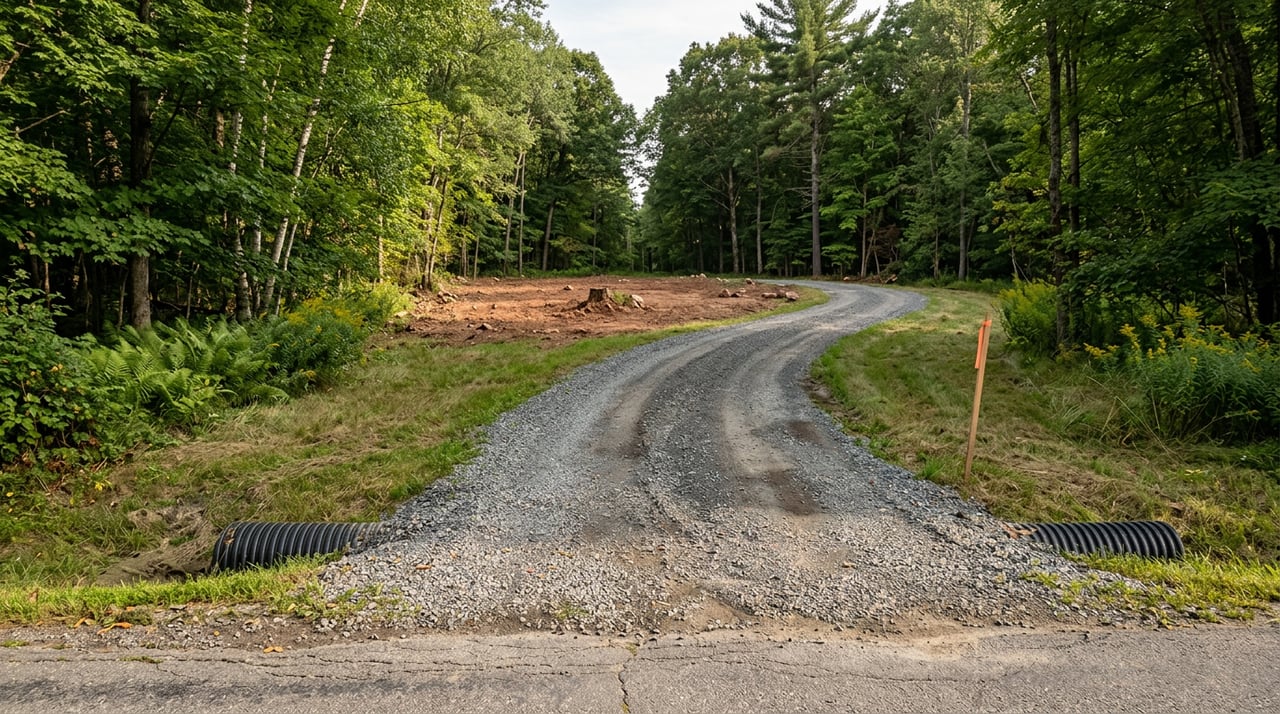
Buying Land in Cambridge VT: Key Checks Before You Sign
August 6, 2026
August 6, 2026
Most buyers arrive at a Cambridge land deal expecting to worry about zoning. Cambridge does not have any. Repeated town-wide votes have declined to adopt zoning regulations, so development here is governed by Flood Hazard Area Bylaws from 1995 and Subdivision Regulations adopted in 2006, and nothing else at the local level. That absence sounds like freedom. In practice, it moves the entire regulatory weight of your purchase onto a single state document: the Wastewater System and Potable Water Supply Permit.
Whether that permit is already in hand on the parcel you are considering is the fact that decides your closing timeline, your contingency structure, and how much room you have to negotiate. It matters more than the listing price. It matters more than the acreage. And it is the one thing a portal photo cannot tell you.
Vermont adopted universal jurisdiction over septic and potable water permits on July 1, 2007. Since then, every new build, subdivision, or replacement system in the state has required a WW permit issued by the Department of Environmental Conservation's regional office. The design must be prepared and submitted by a Vermont-licensed Class A, Class B, or Class B(d) Designer. A homeowner cannot draw the system, and a homeowner cannot file the application. That professional bottleneck is the single most common reason a Cambridge land contract slips its closing date.
Two mechanics inside that framework quietly shape almost every rural transaction here:
If the seller cannot produce a WW permit, you are not necessarily looking at a bad parcel. You are looking at a parcel where a licensed designer needs to walk the soils, run percolation testing, and produce a design that DEC will approve, and where your contract needs a contingency that reflects that timeline.
Buyers hear "Act 250" and assume it applies to any rural Vermont purchase. It typically does not. Act 250 review is triggered by construction of 10 or more housing units within 5 years, subdivision of land into 10 or more lots within 5 years, or larger commercial scopes. A single-family home on an existing residential parcel almost never triggers it. If your Cambridge purchase is one house on one lot, your regulatory exposure is the WW permit and, where relevant, the flood hazard bylaw. That is a meaningfully lighter lift than a first-time buyer assumes when they read the state guides.
Where Act 250 does creep in: if you are buying acreage with an eye toward eventually splitting it, or if the parcel touches a mapped wetland or falls within 250 feet of a lake, stream, or river under the Shoreland Protection Act. In those cases the state's Permit Navigator and a conversation with a licensed designer before you write the offer are worth the hour.
Cambridge is a research town, not a look-up town. The information exists, but you have to go get it. Before removing contingencies, confirm the following on the specific parcel:
None of this is exotic. All of it is quietly capable of extending a 45-day closing into a 120-day one if it surfaces after you are under contract instead of before.
The regulatory friction is real. So is the buyer's leverage on the other side of it.
Lamoille County posted the region's strongest land-price appreciation in 2025, with the median land sale price rising 36 percent to $120,000, per the Hickok & Boardman Vermont Land Market Report. On the surface that reads as a seller's market. The rest of the same data set tells a more useful story: across northwest and central Vermont, land sales fell nearly 30 percent in the first half of 2026 as buyers weighed construction costs, contractor availability, and development expenses more carefully, and the average days on market for land climbed to 134 days in 2025, up 8 percent year over year. New listings across the region rose 9.6 percent.
Read those numbers together and a specific pattern emerges. Priced-right parcels with clean paperwork still trade quickly at strong numbers. Parcels missing a WW permit, or sitting in awkward soils, or lacking clear road access, sit. That gap is where a prepared buyer earns a discount. In this market, a seller who has held a raw parcel through a full spring and summer has watched the pool of qualified buyers narrow, because rising build costs have made buyers pickier about anything that adds uncertainty on the front end.
Two practical implications for the offer you write:
Do I need Act 250 for one house on one lot in Cambridge? Almost never. Act 250 targets larger subdivisions and commercial development. Your permit exposure is the state WW permit and, where applicable, the flood hazard bylaw and Shoreland Protection Act.
The seller says the lot is "grandfathered." Is that enough? Only for the improvements that existed before January 1, 2007. Any new construction, added bedroom, subdivision, or system replacement pulls the parcel into the current rules and requires a permit prepared by a licensed designer.
Can I hire my own installer and skip the designer? No. Vermont centralizes WW oversight at the DEC, and every application must be prepared by a licensed Class A, B, or B(d) designer. The installer builds to the approved design and the designer certifies the completed work back to DEC.
Where do I find the permit history on a specific Cambridge parcel? Two places. Post-September 2007 records are at the DEC Wastewater Management Division. Records from 1988 through 2007 are at the Cambridge Town Clerk's office and are filed by the landowner's name at the time of application. The town also maintains property information and land records online where available.
Is buying raw land still a good move when regional land sales are down? The volume decline is a story about buyer selectivity, not falling demand. Well-documented parcels with clean permit histories continue to sell at strong numbers. The parcels that sit are the ones with unresolved questions, and those questions are increasingly the buyer's negotiating tool rather than a reason to walk.
Every rural Cambridge parcel tells its story through paperwork the seller may not even remember they have. Confirming permit history, soils, access, and any overlay bylaws before you commit is the difference between a clean 60-day close and a deal that reopens every two weeks. When the market slows the way it has this year, that preparation is also what earns the price adjustment.
If you are weighing a Cambridge parcel and want the permit questions answered before you write, Jill Richardson has spent more than 20 years walking Lamoille County land deals through the town clerk's vault and DEC's regional office. Request a free consultation and property review, and bring the map coordinates. The rest is a phone call.
Stay up to date on the latest real estate trends.
Contact Jill today to learn more about her unique approach to real estate and how she can help you get the results you deserve.
44 Main St VT-108 Jeffersonville, VT 05464